On-site LOTO placard production, gap analysis, and annual audit services for automotive and manufacturing facilities throughout Southeast Michigan. We understand the demands of Detroit's production environments.
Detroit Service Area
No region in the country has a denser concentration of heavy industrial equipment than Southeast Michigan. Stamping plants, assembly lines, body shops, powertrain facilities, and Tier 1 supplier operations across the Detroit metro run equipment that demands precise, documented lockout tagout procedures at every workstation.
Michigan operates under OSHA's Federal enforcement program and is one of the most inspected states in Region 5. Automotive facilities in particular face significant LOTO scrutiny because the equipment hazards are high-severity: stamping presses, robotic welding cells, conveyor systems, and hydraulic assembly tooling all require complete energy control procedures. A missing step or an incomplete placard in an automotive production environment is not a paperwork problem. It is an injury waiting to happen.
We serve facilities throughout Wayne, Oakland, Macomb, Washtenaw, Monroe, and Livingston counties. Our on-site team is experienced in the operational tempo of automotive production and can work around shift schedules and production commitments.
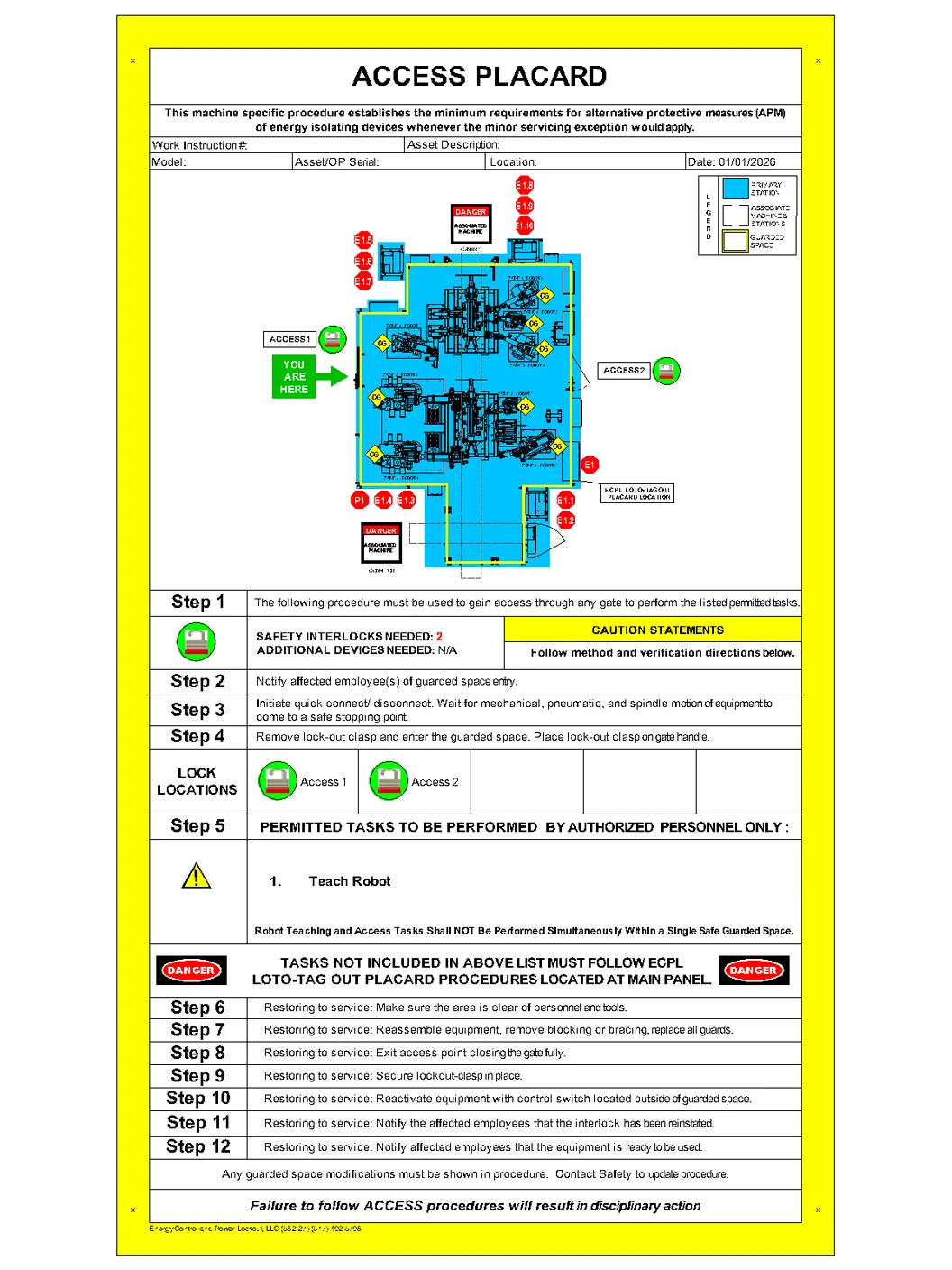
Automotive LOTO complexity: Tier 1 and Tier 2 automotive suppliers frequently operate multi-energy equipment where electrical, pneumatic, and hydraulic systems must be isolated in a specific sequence. Generic placards or internally written procedures rarely capture this correctly. Missing a pressure source or a stored energy release step creates exactly the kind of exposure OSHA inspectors look for.
Industries Served
From OEM assembly plants to Tier 1 suppliers, stamping operations, and beyond, we serve every segment of Southeast Michigan's industrial economy.
Assembly plants and OEM facilities operate some of the most complex multi-energy equipment in any industry. Body shops, paint lines, powertrain assembly, and final assembly all require complete LOTO procedures for every workstation and every energy source.
Stamping presses are among the highest-hazard machines in manufacturing and among the most frequently cited under 1910.147. We produce stamping-specific LOTO placards that cover mechanical energy storage, pneumatic systems, and hydraulic counterbalances.
Robotic welding cells and automated assembly systems require access control placards and energy isolation procedures that account for teach mode, auto mode, and maintenance access. Most standard LOTO programs do not address robotic access correctly. See our robotics placard service.
Supplier facilities frequently face customer-mandated compliance audits in addition to OSHA enforcement. A documented, complete LOTO program with durable placards is a requirement for maintaining preferred supplier status with OEM customers.
Die casting and foundry operations combine electrical, hydraulic, and thermal energy hazards in a single machine. The complexity of these procedures requires direct on-site assessment to document correctly. Templates will miss critical isolation steps.
Southeast Michigan hosts a growing aerospace and defense manufacturing base alongside the automotive sector. These facilities operate precision machining equipment and specialized assembly tooling that requires the same level of LOTO documentation rigor.
What We Provide
Machine-specific placards built from direct on-site observation of your equipment. 200-year coated aluminum construction. Every energy source documented with isolation steps and required lockout device types.
View Placard Services →Facility-wide assessment that identifies every deficiency in your current LOTO program and maps each finding to its specific OSHA, ANSI, or ISO citation. Delivered as a formal report with prioritized remediation recommendations.
View Gap Analysis →OSHA-required annual review of every authorized employee's lockout tagout performance. Available as a full-service program or through LockStep software for facilities that want a managed, auditable system.
View Annual Audit →Automotive Production Reality
Automotive production equipment presents LOTO challenges that go beyond what most internally written programs address. The three most common gaps we find in Detroit-area facilities are:
Incomplete robotic cell procedures. Robotic welding and assembly cells require separate access control procedures for teach mode, collaborative zones, and full lockout during maintenance. Most facilities have a single generic LOTO procedure that does not address mode-specific access. This is a direct violation of OSHA 1910.147 and ANSI/RIA R15.06.
Missing pneumatic energy release steps. Stamping, welding, and assembly equipment typically has pneumatic circuits that retain pressure after electrical lockout. LOTO procedures that do not include pneumatic bleed-down steps create exposure even when the machine appears to be locked out.
Outdated procedures after equipment modifications. Automotive facilities modify and retool equipment frequently. Procedures that were accurate at time of installation may no longer reflect the actual equipment after tooling changes, retrofit automation, or process modifications. Annual review programs exist specifically to catch this.
Maximum OSHA penalty per serious 1910.147 violation in 2025
1910.147 consistently ranks among OSHA's top 10 most cited standards
Workers injured annually due to inadequate energy control procedures
Rated lifespan of our coated aluminum placard materials
FAQ
Yes. We understand that production downtime is costly in automotive environments. We schedule on-site assessments around your production calendar and can work during planned downtime windows, shift changes, or off-shifts to minimize disruption to operations.
Yes. We produce the full documentation package required for supplier audits, including machine-specific procedures, a written energy control program, training records framework, and annual review documentation. The deliverables we provide are designed to satisfy both OSHA and customer audit requirements.
Yes. Robotic and automated equipment is one of our specialties. We produce access control placards and energy isolation procedures that address all operating modes under OSHA 1910.147 and ANSI/RIA standards. This is one of the most common compliance gaps we find in Detroit-area facilities. See our robotics placard service for details.
The number depends on equipment complexity and facility size. For a typical Tier 1 supplier with moderate equipment density, we can assess and document procedures for 20 to 40 machines per on-site day. We provide a scope estimate before the visit so you know what to expect. Larger facilities typically require multiple visits, which we plan around your operational schedule.
Michigan operates under Federal OSHA jurisdiction, which means 29 CFR 1910.147 applies directly with no state-specific variations. The compliance requirements are identical to Federal OSHA standards. Our assessments are built around the Federal standard, so Michigan facilities are fully covered.
Tell us about your facility and we will follow up within one business day to discuss your LOTO compliance needs and schedule an on-site visit.