Central Indiana's pharmaceutical manufacturing corridor (Eli Lilly and suppliers) sits under FDA cGMP requirements on top of OSHA 1910.147, which means LOTO programs here must integrate with validated SOPs. Gap analyses in this sector often surface documentation overlap failures rather than isolation failures. Source: FDA 21 CFR 211 and OSHA cross-reference. We run on-site LOTO placard production, gap analysis, and annual audits across Central Indiana.
Indianapolis Service Area
Indianapolis has one of the Midwest's most diverse industrial economies. A significant pharmaceutical and life sciences manufacturing base. A growing automotive assembly and supplier sector. Substantial food and consumer products manufacturing. Large-scale warehousing and distribution operations feeding regional and national supply chains.
Warehousing and distribution operations across Hendricks and Hancock counties have expanded faster than their energy control documentation. Conveyor and sortation energy sources are frequently under-procedured in facilities built or converted in the last five years.
Indiana operates under Federal OSHA jurisdiction, and OSHA Region 5 enforcement in the state has increased activity around high-hazard industries including manufacturing and pharmaceuticals. Central Indiana facilities face the same LOTO compliance exposure as any other major manufacturing region. 1910.147 violations run up to $16,550 per serious and up to $165,514 per willful or repeat.
We serve facilities throughout Marion County and the surrounding region, including Hendricks, Hamilton, Hancock, Johnson, and Morgan counties. Pharmaceutical production equipment, automotive stamping lines, automated warehouse systems. Our certified specialists come on-site to document every energy isolation procedure accurately.
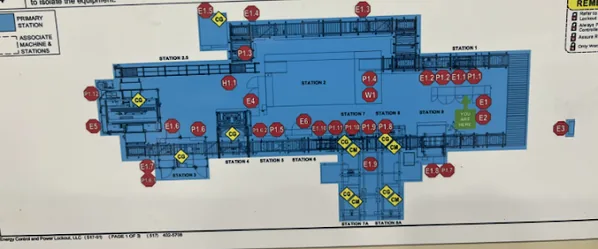
Life sciences and pharmaceutical note: Pharmaceutical and medical device manufacturers in Indianapolis face dual compliance requirements. In addition to 1910.147, FDA-regulated facilities must demonstrate control of equipment maintenance processes that affect product quality. A well-documented LOTO program supports both frameworks simultaneously. Missing documentation is a finding in OSHA inspections and FDA audits alike.
Industries Served
From life sciences and pharmaceutical manufacturing to automotive assembly and high-volume distribution. Every major sector in Central Indiana.
Indianapolis is one of the most significant pharmaceutical manufacturing cities in the country. Production equipment for tablets, injectables, and medical devices requires complete, accurate LOTO procedures. These facilities also benefit from the documentation structure of a formal LOTO program as part of broader quality and compliance frameworks.
Central Indiana hosts several major automotive assembly operations and a large Tier 1 and Tier 2 supplier base. These facilities run stamping, welding, and automated assembly equipment with multi-energy lockout requirements that demand machine-specific procedures.
Large-scale food, beverage, and consumer products manufacturing operations across the Indianapolis area run production lines, mixers, packaging equipment, and conveyors that require complete LOTO coverage. Paper and laminate placards degrade quickly in these environments.
Indianapolis is a major national logistics hub. Large distribution and fulfillment centers run automated conveyor systems, high-bay storage equipment, and powered material handling systems that create significant LOTO exposure. Warehouse LOTO programs are frequently incomplete or absent.
Fabrication and machining shops throughout the Indianapolis metro serve both the automotive and industrial sectors. Stamping presses, CNC machining centers, and welding equipment all require documented lockout tagout procedures with durable point-of-use placards.
Hospitals and large healthcare facilities run mechanical, electrical, and HVAC equipment subject to 1910.147. Healthcare facilities are frequently unaware that LOTO requirements apply to their maintenance operations. Compliance gaps in this sector are common and correctable.
What We Provide
Machine-specific placards produced from direct on-site assessment. 200-year coated aluminum. Every energy source documented step-by-step, installed at point of use. Meets OSHA, ANSI Z535, and ISO standards.
View Placard Services →On-site assessment identifying every deficiency in your LOTO program, mapped to specific regulatory sub-clauses. Delivered as a formal findings report with prioritized remediation guidance.
View Gap Analysis →1910.147(c)(6) annual review of every authorized employee's energy control performance. Managed service or LockStep software platform.
View Annual Audit →Why It Matters
LOTO compliance is not a regulatory checkbox. A single OSHA citation or workplace injury costs more than a complete compliance program.
Maximum OSHA penalty per serious LOTO violation
Maximum penalty per willful or repeat 1910.147 violation
FY2025 1910.147 citations (OSHA Top 10)
1910.147 rank on OSHA's FY2025 Top 10 cited standards
The math is straightforward. A complete LOTO placard and documentation program for a 200-machine facility costs a fraction of a single serious OSHA citation. A gap analysis costs far less than the remediation required after an inspector identifies the same issues. The time to address LOTO compliance is before the inspection, not during it.
FAQ
Indiana operates under Federal OSHA jurisdiction. 29 CFR 1910.147 applies directly, no state-specific modifications. OSHA Region 5 enforcement covers Indiana, and facilities face the same inspection processes and penalty structures as any other Federal OSHA state.
Yes. 1910.147 applies to pharmaceutical manufacturing wherever employees perform maintenance, servicing, or repair on equipment with hazardous energy. Production equipment, utilities, HVAC, and associated machinery. Pharmaceutical facilities are also subject to FDA inspection of maintenance procedures, and a documented LOTO program supports both regulatory requirements. See our gap analysis service to understand your current exposure.
Yes. Powered conveyor systems, automated sortation equipment, and dock levelers all fall under 1910.147. Distribution and warehousing is an area of increasing OSHA enforcement focus because LOTO programs in this sector are frequently absent or incomplete. A gap analysis will identify every point of exposure in your operation.
A typical Indianapolis-area facility with 50 to 150 pieces of equipment, a comprehensive gap analysis runs one to two on-site days. We provide a detailed scope estimate before the visit based on the information you provide. After the site visit, you receive a written findings report within a few business days.
Yes. For facilities without an existing energy control program, we deliver a complete build. Written energy control program, machine-specific procedures for every piece of equipment, durable placard production and installation, training frameworks, and annual audit setup. See our Full-Service LOTO Program for details on end-to-end program development.
Tell us about your facility and we follow up within one business day to discuss compliance needs and schedule an on-site visit.